Client submits application
Client submits application for initial certification.
QAICPL follows a structured third-party audit and certification process designed to confirm scope, appoint competent auditors, conduct stage audits and maintain confidence throughout the certification cycle.
Initial certification is followed by ongoing surveillance activities and re-certification before expiry.
Select the management system standard relevant to your organisation and share your certification scope when making an enquiry.
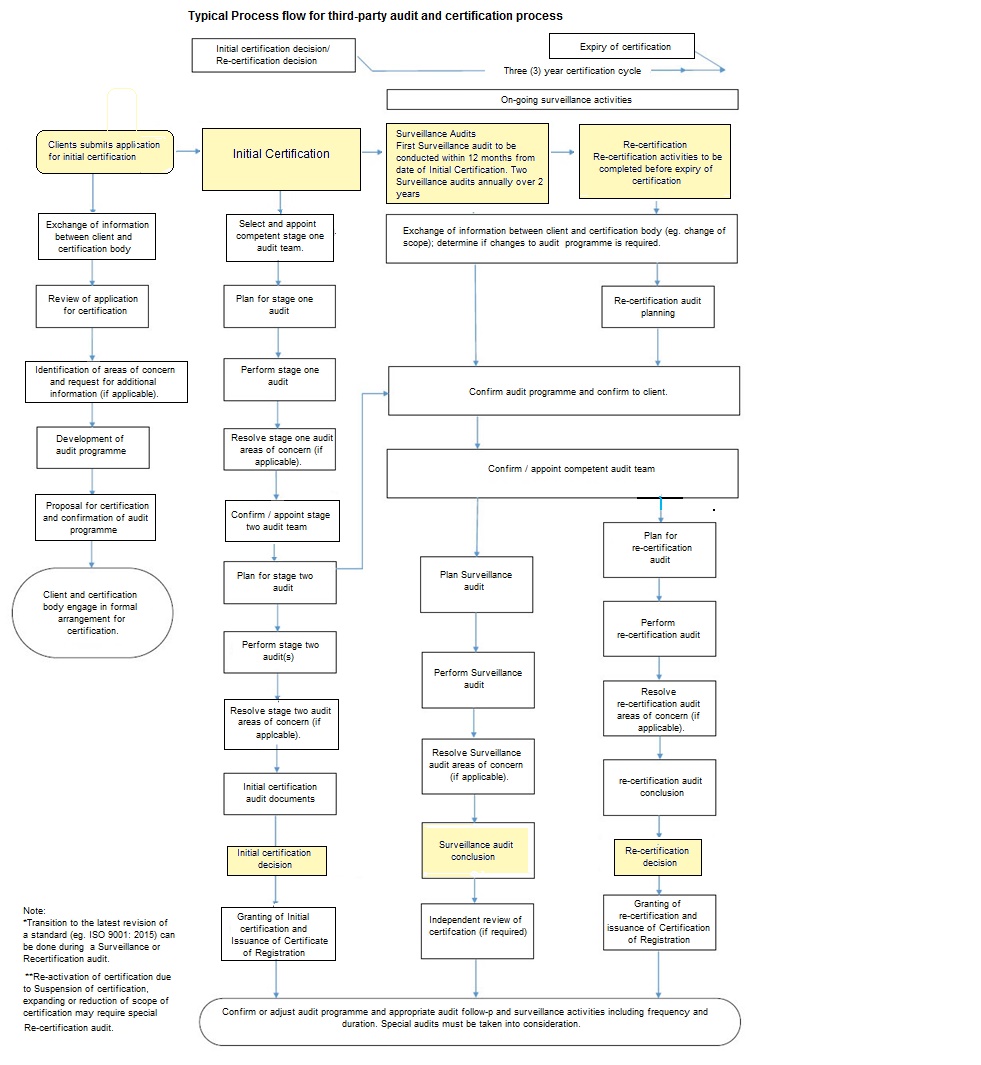
The reference flowchart from the previous QAIC site is preserved below. Select the image to enlarge it.
Client submits application for initial certification.
Exchange of information between client and certification body.
Review of application for certification.
Identification of areas of concern and request for additional information, if applicable.
Development of audit programme.
Proposal for certification and confirmation of audit programme.
Client and certification body engage in formal arrangement for certification.
Initial certification activities proceed through stage one audit, stage two audit, certification decision and issuance of Certificate of Registration.
Select and appoint competent stage one audit team.
Plan for stage one audit.
Perform stage one audit.
Resolve stage one audit areas of concern, if applicable.
Confirm and appoint stage two audit team.
Plan for stage two audit.
Perform stage two audit(s).
Resolve stage two audit areas of concern, if applicable.
Prepare initial certification audit documents.
Make initial certification decision.
Grant initial certification and issue Certificate of Registration.
Ongoing activity is planned across the three-year certification cycle, including surveillance audits and re-certification before expiry.
The first surveillance audit is to be conducted within 12 months from the initial certification date. Two surveillance audits are normally conducted annually over two years.
QAICPL exchanges information with the client, such as changes of scope, to determine whether changes to the audit programme are required.
The surveillance audit is planned, performed and reviewed. Any surveillance audit areas of concern are resolved if applicable before conclusion.
Re-certification activities are completed before certificate expiry, followed by re-certification audit planning, audit performance, resolution of concerns, audit conclusion, re-certification decision and issuance of Certificate of Registration.
Transition to the latest revision of a standard, such as ISO 9001:2015, may be carried out during a surveillance or re-certification audit.
Reactivation of certification due to suspension, or expansion or reduction of certification scope, may require special or re-certification audit activity.
Share your organisation scope, standard, location, headcount and target timeline so QAICPL can guide the right next step in the certification process.
Start an enquiry